Research interest
Chromosomes are living information media within the cell, integrating digital genetic information with their physical entity. The processing of this information relies on molecular interactions, thermodynamic fluctuations, and mechanical forces. Our lab is interested in the dynamic mechanisms that define the dual nature of chromosomes.
Our focus
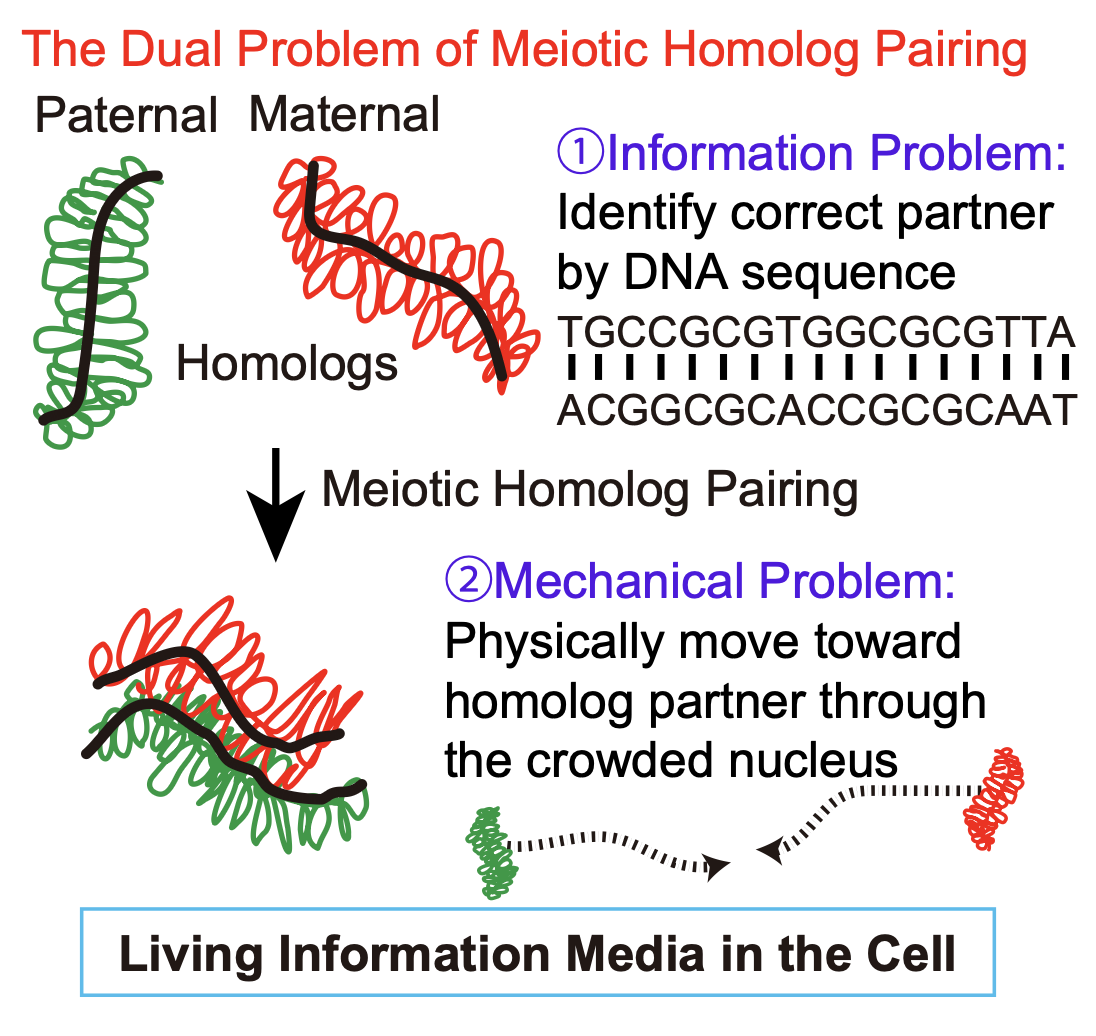
We are diploid. We have 46 chromosomes: 23 from our biological father and 23 from our mother. During meiosis, each chromosome must pair with its homologous partner. How chromosomes accomplish this pairing remains a long-standing unsolved problem. Pairing failure causes aneuploidy, the leading genetic cause of miscarriage, infertility, and congenital disorders.
Pairing requires solving two problems simultaneously: each chromosome must identify its correct partner by DNA sequence (an information problem), and then physically move through the crowded nucleus to reach that partner without entanglement (a mechanical problem). This phenomenon provides one of the clearest demonstrations of the dual nature of chromosomes.
Research progress in meiotic homolog pairing has long been hindered by the difficulty of visualizing and tracking chromosomes in living meiotic cells. By developing 4D long-term live-cell imaging of fluorescently labeled homologous loci throughout meiosis in budding yeast, we discovered Rapid Homolog Juxtaposition (RHJ): a multi-step process in which homologs transition from far apart to fully paired in minutes, with a short arrest at an intermediate stage corresponding to the cytological coalignment stage (Nozaki et al., Nature 2024). The speed and directionality require active, energy-dependent mechanisms rather than passive diffusion. RHJ now provides a quantitative live-cell assay for pairing. By combining it with yeast genetics, chromosome engineering, and quantitative approaches, we aim to develop a multi-scale framework connecting DNA-level mechanisms to chromosome-scale behaviors across eukaryotes.
Research projects
1. Chromosome dynamics
How do homologous chromosomes pair during meiosis? What mechanical force drives chromosomes to pair together across nuclear distances? Our data suggest that chromosomes are physically connected by recombination-mediated DNA linkages even when separated by ~1.6 µm, indicating that force originates from within the linkage itself. We are dissecting the molecular and physical nature of these linkages by live-cell imaging and yeast genetics.
2. Algorithms in the cell
How is genetic information efficiently searched and recognized? How much sequence identity is required, and how does the cell search so quickly? We are addressing these questions with engineered yeast strains and live-cell imaging of homology recognition.
3. Evolution of chromosomes
Why and how do chromosome size, number, and shape vary so widely across eukaryotes? Chromosome size ranges from 1 Mb in yeast to over 10 Gb in plants, and ploidy varies from diploid (2n) to at least dodecaploid (12n), raising the question of how pairing mechanisms scale. We are asking how pairing scales with chromosome size and ploidy, using engineered yeast and live imaging of meiosis in other organisms.
Join us
We are recruiting graduate students and postdoctoral researchers to lead projects on chromosome dynamics and meiotic homolog pairing. Fellowship-funded postdocs and visiting scientists with their own projects are also welcome. Please contact Tadasu Nozaki.
We also welcome undergraduate researchers interested in chromosomes and genetics. Positions for UMass Amherst undergraduates are posted on PROPEL; please check PROPEL regularly or contact Tadasu Nozaki directly.